No user accounts required for your recipients -
Start your 7-day free trial now!

How modern digital badges shape learning recognition, boost engagement and expand course visibility


Digital badges are no longer a niche concept. They are becoming a core element of modern credentialing for education providers such as training organizations, universities, and certification bodies. As learning formats evolve and move further into digital and hybrid environments, the way achievements are recognized must evolve as well.
Traditional certificates in PDF or paper form struggle to meet today’s expectations. They are static, easy to copy, and difficult to verify. In contrast, digital badges offer a dynamic and verifiable alternative that aligns with how people learn, share, and build careers today.
For education providers, this shift is not just a technical change. It is a strategic decision that affects branding, credibility, and learner engagement.
One of the most important trends in digital credentials is the growing demand for verifiable digital badges. Trust is a critical factor in education, and verification is what separates meaningful credentials from simple visual symbols.
A verifiable digital badge, issued according to the Open Badge Standard, contains embedded information that proves its authenticity. This data can be checked online at any time, without contacting the issuer directly.
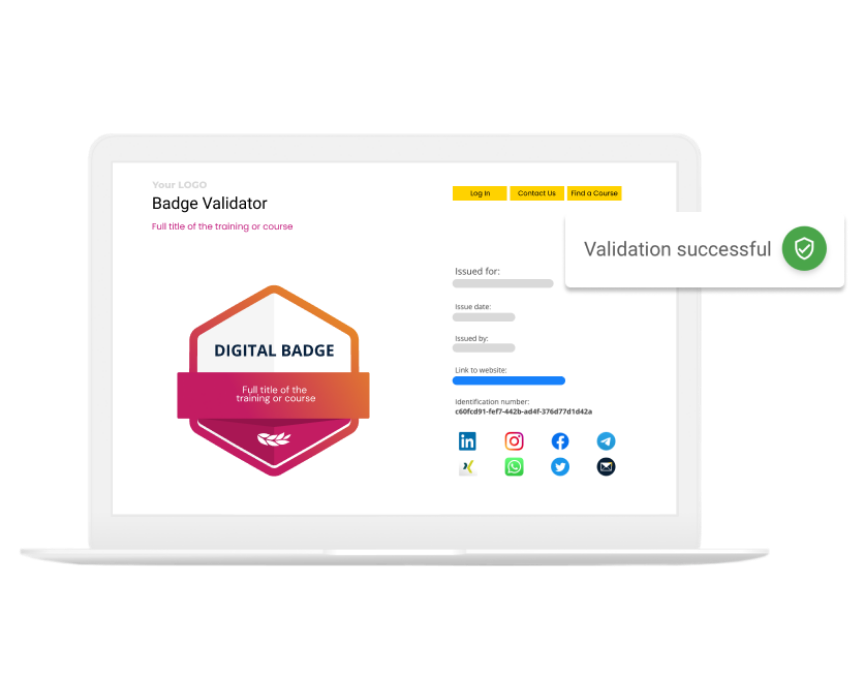
In a landscape where digital certificates can be copied within seconds, verifiability becomes a competitive advantage. Education providers who adopt verifiable digital badges position themselves as reliable partners for learners, employers, and institutions alike.
Digital badges create visibility where traditional certificates do not. Once issued, a badge can be shared directly on professional platforms and becomes part of a learner’s public profile.
For education providers, this turns credentialing into a passive but continuous marketing channel.
Another article explains this effect in more detail in the blog article “How Sharing Digital Badges Boosts Reach and Social Proof”, which shows how education providers benefit when learners actively share their credentials across professional networks.
Instead of promoting courses only before enrollment, digital badges extend visibility after the learning experience, without additional marketing effort.
Manual certificate workflows limit growth. Automation removes this limitation by issuing digital badges automatically once criteria are met.
This trend is especially relevant for education providers with recurring courses, large cohorts, or compliance driven certifications.
A practical example is the success story of CPR Education, a training provider in emergency and first aid education. By automating the issuance of digital certificates and badges, CPR Education streamlined its processes and ensured that participants received verifiable credentials without delays or manual effort.
Automation enables education providers to scale without increasing administrative complexity, while maintaining quality and trust in their credentials.
Digital badges are no longer just a trend. They are a strategic tool for education providers who want to increase trust, visibility, and efficiency.
Schedule a free 15-minute demo to see how Virtualbadge.io helps you issue, automate, and manage digital badges and certificates. We will show you how our software fits into your existing processes and how you can start delivering verifiable credentials with minimal effort.
* You can find the organisation ID in the URL when you access your LinkedIn Company page as an admin.


Marketing

Jan 22, 2026

4 min
A note on how we write: we use AI tools to help with research and drafting. Every article is then reviewed, edited and fact-checked by someone on the Virtualbadge.io team before it goes live. The final word is always human.

Use Virtualbadge.io to design and send digital certificates that create trust - in less than 10 minutes.
%20(1).svg)