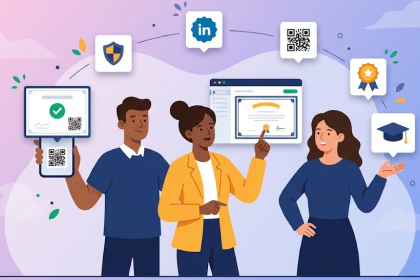
No user accounts required for your recipients -
Start your 7-day free trial now!

What digital badges are, why they matter and how organisations can leverage them effectively



Digital badges have become a central element of modern credentialing. As education shifts toward online formats and flexible learning paths, organisations require reliable, verifiable and shareable ways to recognise achievements. Traditional methods such as printed or PDF certificates often fall short because they cannot ensure authenticity or provide meaningful online visibility.
Digital badges solve these challenges by offering a secure, verifiable and metadata-rich form of recognition. They allow organisations to certify skills and learning outcomes in a way that is transparent, engaging and easy to distribute.
Key reasons why digital badges are becoming essential
This article explains what digital badges are, why they matter and how organisations can use them effectively to strengthen their training and certification processes.

Digital badges are verifiable digital credentials that represent an achievement, a skill or a completed learning activity. Unlike simple image files, a genuine digital badge contains embedded metadata that identifies the issuer, the purpose of the badge, the criteria for earning it and the date of issuance.
This structure ensures that every badge remains traceable and tamper resistant, which significantly increases trust.
A digital badge typically includes
These elements distinguish digital badges from paper or PDF certificates, which can be copied or manipulated. A properly issued digital badge connects to a secure validation page, allowing anyone to confirm the badge's authenticity in real time.
On the Virtualbadge.io platform, organisations can create digital badges with a built-in verification mechanism and custom metadata. The solution provides intuitive tools to design badges, upload recipient lists and issue verified credentials at scale.
More information on Virtualbadge.io.
Learners expect recognition that is instant, verifiable and professionally visible, and organisations require certification methods that match the pace of modern learning.
Key reasons why digital badges are rising in importance
Virtualbadge.io explains this shift in more detail in its article: How digital badges build trust
For organisations, digital badges improve administrative efficiency, strengthen branding and enhance learner engagement. They deliver a level of credibility and transparency that traditional formats cannot match.
Digital badges create value on both sides. Organisations gain efficiency and credibility, while learners receive modern and meaningful recognition for their achievements.
Virtualbadge.io highlights how automation and verification support these organisational goals
These combined benefits make digital badges a powerful tool for strengthening learning outcomes and supporting modern education strategies.
Implementing digital badges effectively requires a clear and structured approach. When organisations define badge criteria, automate issuance and guide learners on how to use their badges, the result is a smooth, transparent and motivating credentialing experience.
A practical implementation strategy focuses on clarity, automation and communication. Each badge should clearly reflect an achievement, be visually aligned with the organisation’s branding and include transparent metadata that can be verified at any time.
Recommended steps for implementing digital badges
Virtualbadge.io supports all these steps with intuitive creation tools, automated workflows, verification features and flexible badge designs.
For a complete step-by-step guide, see: How to create digital badges for Online Courses
Schedule a free demo with our team and see how easily your organisation can implement digital badges with Virtualbadge.io.
* You can find the organisation ID in the URL when you access your LinkedIn Company page as an admin.


Marketing

Dec 8, 2025

4 min
A note on how we write: we use AI tools to help with research and drafting. Every article is then reviewed, edited and fact-checked by someone on the Virtualbadge.io team before it goes live. The final word is always human.

Use Virtualbadge.io to design and send digital certificates that create trust - in less than 10 minutes.
%20(1).svg)