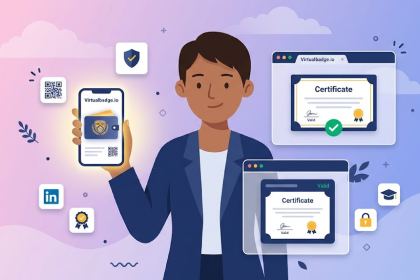
No user accounts required for your recipients -
Start your 7-day free trial now!

Why employers increasingly trust digital badges and how education providers can make their credentials truly impactful


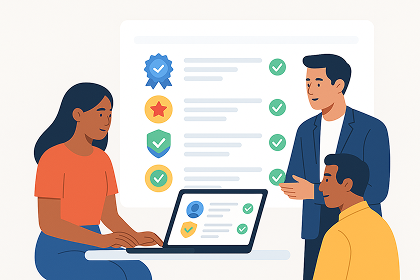
The credibility of a qualification depends on how easily its authenticity and content can be understood. In modern hiring processes, employers want clear proof of skills, transparent evaluation criteria and reliable verification methods. Traditional certificates often fail to deliver on these expectations.
Many digital badges are based on the Open Badges standard, a globally recognized framework for verifiable digital credentials. It ensures that badges contain structured, interoperable data such as issuer information, criteria and evidence, making it easier for employers to understand and verify across platforms.
Learn more about the Open Badges standard: https://openbadges.org
Key challenges with legacy formats such as PDFs or paper documents include
For education providers such as first aid institutions or universities, these limitations affect the perceived value of their programs. When employers cannot easily trust a certificate, learners lose part of the benefit of completing a course.
Digital badges respond directly to these concerns by providing:
Trust is becoming a decisive factor in credentialing. Digital badges help institutions strengthen credibility, meet employer expectations and offer learners more meaningful recognition.
Digital badges are visual, online credentials that represent verified achievements. They differ from traditional certificates because they include embedded metadata that employers can inspect to confirm authenticity and relevance.
A digital badge typically includes
Why digital badges are more reliable than PDFs
How Virtualbadge.io enhance this system
By offering verified, structured and accessible information, digital badges create a level of transparency that traditional certificates cannot match. This clarity directly strengthens employer trust and increases the value of the credential for learners.
Employer attitudes toward digital badges have evolved significantly in recent years. As hiring processes become more data driven and technology oriented, companies increasingly value credentials that are verifiable, transparent and easy to interpret. Digital badges fulfill these criteria more effectively than traditional certificates.
Key reasons employers trust digital badges
Recruiters often face a high volume of applications. They need quick ways to assess the relevance and authenticity of qualifications. Digital badges reduce uncertainty by offering
Comparison to traditional certificates
For more information, read our article on Virtualbadge.io: Open Badges vs PDFs. What Employers Prefer Today, which highlights the increasing importance of verifiable and structured credentials in hiring.
Overall, employer trust in digital badges continues to rise because they offer clarity, reliability and efficiency. As more companies adopt digital HR tools, badges become a natural fit for the hiring ecosystem.
Education providers play a central role in shaping how employers perceive digital credentials. To make badges meaningful and trustworthy, institutions must design them with clarity, accuracy and purpose.
Essential strategies for creating credible digital badges
How metadata strengthens trust
Increasing visibility and relevance
Operational benefits for institutions
By focusing on clarity, structure and verification, education providers can ensure that their digital badges become trusted signals of competence. This strengthens the value of their programs and improves the career outcomes of their learners.
Digital badges have become a powerful tool for strengthening trust between education providers, learners and employers. Their value lies in the combination of transparent information, clear skill definition and reliable verification. Employers increasingly prefer credentials that offer context and authenticity, and digital badges deliver exactly that. They allow hiring teams to understand not only what a learner completed but also how their competence was assessed and validated.
To move forward effectively, institutions should
Digital badges can only make an impact when they are issued with precision and purpose. With the right tools, education providers can elevate the quality of their credentials, increase employer trust and support learners with verifiable proof of their skills.
If your institution is ready to modernize its credentialing process and deliver trusted digital badges, you can explore how Virtualbadge.io supports you with secure validation pages, automated issuance and professional badge design.
Schedule a free demo to see how digital badges can transform your certification workflows and strengthen employer trust.
* You can find the organisation ID in the URL when you access your LinkedIn Company page as an admin.


Marketing

Dec 29, 2025

6 min
A note on how we write: we use AI tools to help with research and drafting. Every article is then reviewed, edited and fact-checked by someone on the Virtualbadge.io team before it goes live. The final word is always human.

Use Virtualbadge.io to design and send digital certificates that create trust - in less than 10 minutes.
%20(1).svg)