No user accounts required for your recipients -
Start your 7-day free trial now!

How certification bodies and universities turn exam results into verifiable digital badges automatically.


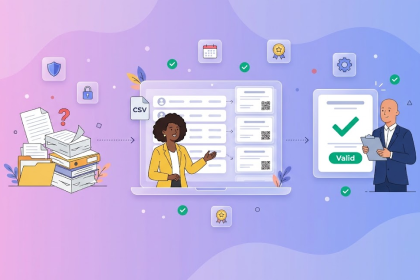
Automated badge issuance describes a workflow in which a passed exam result directly triggers the creation and delivery of a digital certificate or badge. Instead of creating PDFs by hand and sending them out one by one via email, participants receive their credential within minutes of passing.
The manual approach quickly hits its limits as exam volume grows: more errors, longer wait times, staff time tied up in repetitive tasks. Participants who wait days for their certificate perceive that as a weaker impression, regardless of how well the exam itself went.
As soon as someone passes the exam, the result automatically triggers the creation and delivery of the certificate, including name, exam title, and completion date. A central overview enables search, filtering, and, if needed, the revocation or update of individual certificates. There are three practical ways to connect:
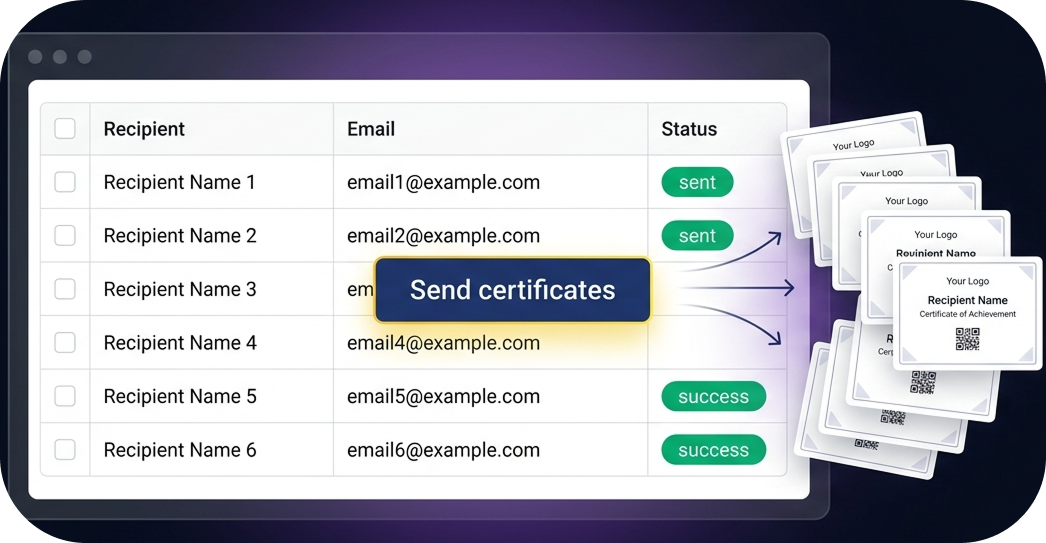
For in-person exams, the Trainer Module is also well suited: participants scan a QR code on-site, enter their own data, and the certificate is sent automatically after approval, with no paper attendance list required.
Participants do not need their own account for this: one click on the link in the email is enough to download, share, or add the credential to their LinkedIn profile. This automation closes exactly the gap that exists in most manual processes: the moment between passing and receiving proof of it.
Open Badges contain structured metadata about issuer, recipient, and criteria, embedded directly in the image file, originally developed by the Mozilla Foundation and now maintained by 1EdTech. This makes credentials tamper-proof, interoperable, and automatically verifiable by employers or authorities.
Open Badges 2.0 remains the most widely used standard in 2026, with high platform compatibility. Open Badges 3.0 additionally aligns with the W3C Verifiable Credentials data model and adds stronger cryptographic signatures as well as wallet compatibility. Providers should support both standards rather than committing to just one.
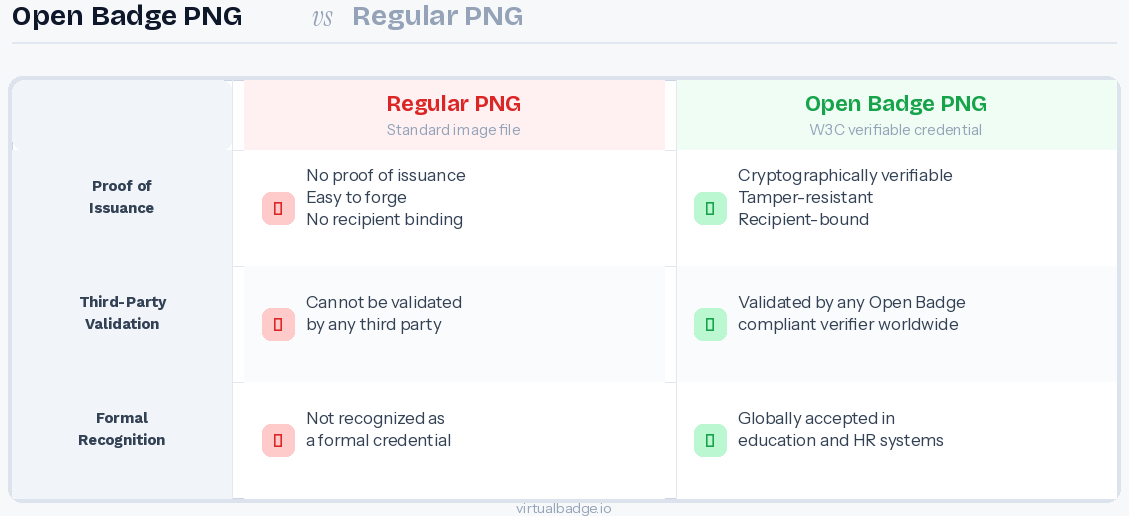
Additional protection comes from each certificate's QR code verification page, where authenticity is confirmed in real time, making forgery significantly harder.
Virtualbadge.io stores all data GDPR-compliant in the EU.
When choosing a platform, standard compliance (Open Badges), integration options (API, Zapier, CSV), data protection, and branding options all matter. Virtualbadge.io covers all four criteria: QR code verification, LinkedIn integration, Apple and Google Wallet support, CSV bulk upload, and API connections, all stored fully GDPR-compliant in the EU. Certificates and badges can also be designed in your own corporate design, including logo, colors, and dynamic fields that are filled in automatically.
More than 1,000 education providers, including SRH, AH Akademie, and the University of Mannheim, already rely on Virtualbadge.io for their digital credentials.
Book a free demo now and see how your exam results turn automatically into verifiable digital badges.
What does automated badge issuance cost?
Costs depend on the number of certificates issued. A seven-day free trial allows you to evaluate the platform before making a decision.
Can existing certificates be digitized retroactively?
Yes, badges can also be issued for already completed exams via CSV upload.
Are Open Badges internationally recognized?
Yes, the open standard is accepted worldwide by educational institutions and employers. The metadata is machine-readable and verifiable on any platform that supports the standard.
Can badges be revoked?
Yes, revocation is shown immediately on the verification page, so invalid credentials can no longer be confirmed as genuine.
How does automated issuance protect against fraud?
Embedded metadata and QR code verification make digital badges significantly harder to forge than PDF certificates, since any manipulation is immediately apparent when scanned.
Is integration with existing exam systems complicated?
No, most integrations can be set up within a few hours using Zapier connectors. No coding skills are required for the basic integration, while direct API connection is relevant for more complex use cases.
* You can find the organisation ID in the URL when you access your LinkedIn Company page as an admin.


Marketing

Jul 8, 2026

5 min
A note on how we write: we use AI tools to help with research and drafting. Every article is then reviewed, edited and fact-checked by someone on the Virtualbadge.io team before it goes live. The final word is always human.

Use Virtualbadge.io to design and send digital certificates that create trust - in less than 10 minutes.
%20(1).svg)