No user accounts required for your recipients -
Start your 7-day free trial now!

How Transparent, Verifiable Credentials Accelerate Hiring and Strengthen Trust Between Education Providers and Employers



Credential transparency means that HR can clearly see what a person has learned, which skills were assessed, and whether a credential is authentic. In modern hiring, this clarity is essential. Resumes are optimized, certificates are easy to edit, and recruiters need reliable proof, not just claims.
When HR receives a traditional PDF certificate, important questions often remain unanswered:
Transparent digital credentials close this gap. Behind the visual badge or certificate, structured data provides context. With a validation link, HR can instantly see the issuer, assessment criteria, date of issue, and in some cases expiration details.
For education providers such as first aid training centers or universities, this creates measurable value. Graduates present credentials that are easy to verify. HR can make faster, more confident decisions because the skills are clearly defined and backed by verifiable information.
As explained in “Do Employers Trust Digital Badges?”, trust increases when credentials are transparent and tied to clear outcomes. Instead of a static document, HR sees reliable proof of competence.
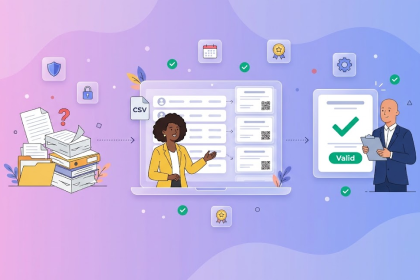
Traditional certificates were designed for a paper-based world. In digital hiring processes, they often create uncertainty and extra work.
Imagine an HR manager reviewing applications for a safety coordinator role. Several candidates attach scanned certificates from first aid or compliance training. The recruiter now has to ask:
Manual verification takes time. In high volume recruitment, these checks are often skipped, which increases risk.
Education providers face limitations as well. When issuing static PDFs, they cannot easily:
For training centers and universities, this reduces the long-term impact of their programs. Graduates carry certificates, but employers struggle to interpret or validate them.
Without transparency, HR loses efficiency and providers lose credibility. Verifiable digital credentials address both issues by combining clarity, authenticity, and speed.
Verifiable digital credentials are designed for a digital hiring environment. They combine a visual certificate or badge with structured, machine readable information that HR can access instantly. Instead of reviewing a static document, recruiters can validate skills with one click.
For HR teams, this directly improves efficiency. A validation page can show:

This level of detail reduces uncertainty. Recruiters no longer have to interpret vague course titles such as “Advanced First Aid Training” or “Project Management Workshop.” They can see what was actually assessed, for example performing CPR under exam conditions or completing a graded logistics simulation.
For education providers, this transparency increases the perceived value of their programs. When credentials clearly describe learning outcomes and assessment standards, employers are more likely to trust them. This strengthens the link between training and employability.
Over time, this structured approach also supports better data driven decisions in HR.

Instead of relying only on resumes, recruiters can compare candidates based on clearly documented, verifiable skills.
A strong example of credential transparency in practice is our Success Story with 4flow. The organization implemented digital badges to make internal skills visible and verifiable across teams.
Before introducing structured credentials, many competencies were documented informally through project experience or internal training records. Managers had limited visibility into who had completed which learning path or mastered specific tools.
By introducing digital badges for defined skills and training programs, 4flow created:
Importantly, these credentials are primarily used within the organization. The goal is not public promotion of employee skills, but structured internal skill transparency.
For HR and training teams, this means faster identification of qualified employees for new projects or roles. Instead of searching through spreadsheets or relying on memory, they can view structured, validated skill records and make better decisions about internal staffing and development.
For education providers, credential transparency does not start with technology. It starts with clarity about learning outcomes and assessment standards. Before issuing digital credentials, organizations should define what skills are being taught, how they are evaluated, and what successful completion truly represents.
A transparent credential typically includes:
For example, a first aid training center can issue separate digital credentials for CPR performance and emergency response coordination. Instead of one generic certificate, each credential reflects a specific, assessed skill. When an employer reviews a candidate, the validation page provides immediate context.
Universities and continuing education providers can apply the same logic to micro-credentials or executive programs. By attaching structured metadata to each credential, they make learning outcomes visible and easy to verify.
In the long-term, transparent credentials strengthen the relationship between education providers and the labor market. They show that the institution does not only deliver training, but also measurable and verifiable results.
If you want to explore how transparent credentials can strengthen employer trust and help HR verify skills faster, schedule a free demo with Virtualbadge.io and see how easily you can implement verifiable digital certificates and badges.
* You can find the organisation ID in the URL when you access your LinkedIn Company page as an admin.


Marketing

Mar 16, 2026

5 min
A note on how we write: we use AI tools to help with research and drafting. Every article is then reviewed, edited and fact-checked by someone on the Virtualbadge.io team before it goes live. The final word is always human.

Use Virtualbadge.io to design and send digital certificates that create trust - in less than 10 minutes.
%20(1).svg)