No user accounts required for your recipients -
Start your 7-day free trial now!

How digital certificates work in regulated industries and what you need to consider to maintain compliance, trust and operational efficiency


Digital certificates play a central role in industries where qualifications must be verifiable, traceable, and compliant. This applies to regulated environments such as first aid training, healthcare education, occupational safety, and higher education. In these fields, certificates are often legal proof of competence, not just documentation.
A digital certificate is a verifiable online credential that confirms the completion of a defined training or course. Unlike paper certificates or static PDF files, digital certificates are designed to be checked independently and remain trustworthy over time.
For education providers in regulated industries, this difference is crucial.
Typical limitations of traditional certificates include:
Digital certificates address these challenges by embedding verification directly into the credential.
Core characteristics include:

For first aid organizations and universities, this enables fast verification by employers, authorities, or partners. It also creates a more robust foundation for audits and accreditation processes.
Trust in regulated industries depends on transparency. Certificates that cannot be verified independently quickly lose credibility. A deeper explanation of these differences is available in the Virtualbadge.io article Digital Certificates Explained.
Regulated industries place strict demands on how training and qualifications are documented. Digital certificates must meet these expectations to be considered valid.
Across most regulated sectors, common requirements include:
For education providers, certificate issuance is therefore a compliance relevant process, not just an administrative one.
Auditability is a key legal factor. Authorities or accreditation bodies often require evidence that:
Paper certificates and static PDFs offer limited control once distributed. They can be copied, edited, or reused without detection.
Digital certificates designed for regulated environments keep verification with the issuer. Instead of trusting a file, third parties validate the certificate directly online.
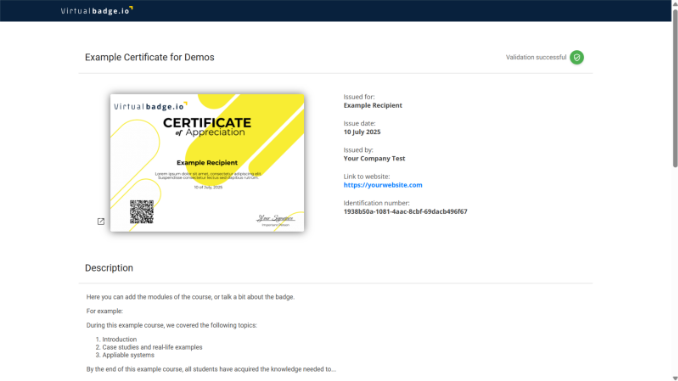
Data integrity is another critical requirement. Many regulations expect records to remain consistent over time or changes to be clearly documented. Non compliance can result in rejected certificates, failed audits, or reputational damage.
This is why regulated training providers increasingly rely on structured digital certificate systems that support both compliance and operational efficiency.
In regulated industries, the technical design of digital certificates directly impacts compliance and trust. To meet regulatory expectations, digital certificates must include several core technical features.
Essential technical components include:
Protection against manipulation is another critical factor. Once a certificate is issued, its content must not be alterable without detection. This ensures long-term reliability during audits and inspections.
Important security related capabilities include:
Interoperability is especially relevant for education providers working with learning management systems. Digital certificates should integrate seamlessly with existing platforms to avoid inconsistencies between training records and issued credentials.
A practical overview is in the article: LMS Integration Guide for Digital Certificates and Badges
Successful implementation of digital certificates in regulated environments requires a structured approach. Simply replacing PDFs with digital files is not enough. Providers should treat certificate digitization as a core process transformation.
A strong implementation typically starts with standardization.
Best practice steps include:
Automation plays a key role for providers issuing certificates at scale. Automated workflows ensure consistent data quality and significantly reduce administrative effort.
When implemented correctly, digital certificates improve audit readiness, reduce operational risk, and strengthen trust with regulators, employers, and participants alike.
For education providers operating in regulated industries, digital certificates are more than a technical upgrade. They are a compliance critical component that directly affects audit readiness, legal certainty, and trust.
A good example of this is the success story SIZ AG, which fully digitized its certificate issuance with Virtualbadge.io. Today, certificates are issued automatically, verified online via validation pages, and managed centrally.
This enables consistent documentation, faster certificate delivery, and reliable verification for external stakeholders in a regulated environment.
When evaluating a digital certificate solution, decision makers should focus not only on usability, but on long term reliability and regulatory fit.
Key criteria to consider include:
If you want to ensure that your digital certificates meet regulatory requirements while remaining easy to manage, it is worth evaluating a solution built specifically for regulated environments.
Schedule a free demo with Virtualbadge.io to see how compliant digital certificates can be issued, verified, and managed at scale.
* You can find the organisation ID in the URL when you access your LinkedIn Company page as an admin.


Marketing

Feb 23, 2026

5 min
A note on how we write: we use AI tools to help with research and drafting. Every article is then reviewed, edited and fact-checked by someone on the Virtualbadge.io team before it goes live. The final word is always human.

Use Virtualbadge.io to design and send digital certificates that create trust - in less than 10 minutes.
%20(1).svg)