No user accounts required for your recipients -
Start your 7-day free trial now!

How modular credentials with badges and certificates help education providers design flexible, transparent learning pathways that improve engagement and institutional value


Stackable micro-credentials are small, focused digital credentials that build toward a larger qualification. Instead of issuing one final certificate at the end of a long program, education providers award credentials for each meaningful milestone along the way.
For example:
Each micro-credential stands on its own. When combined, they form a structured learning pathway.
What makes them powerful is their digital format. As explained in the Virtualbadge.io article “What Are Micro-Credentials?”, digital badges include embedded metadata. This allows:
For education providers, stackability transforms fragmented courses into visible progression. Learners see growth step by step, and institutions communicate structured development instead of isolated training events.
Stackable credentials only create value when they follow a clear structure. A pathway should feel intentional, not random.

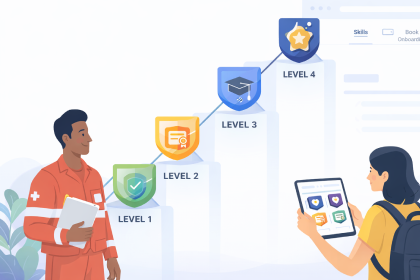
The image shows a strong example. Four Product Management levels are visually connected, from Level 1 to Level 4. Each level signals increasing competence. This makes progress tangible.
When designing your own pathway, define:
For example, a university could create a four level Data Skills pathway:
According to the Virtualbadge.io article “How to Build a Badge Ecosystem That Scales with Your Business,” credentials should not exist in isolation. A badge ecosystem connects levels, departments, and long-term institutional goals.
Stackable micro credentials become even more powerful when issued as Open Badges. Because they follow an open standard, learners can store them in a Digital Backpack, keeping all achievements organized, verifiable, and portable.
For universities, a branded Digital Backpack offered by Virtualbadge.io adds strategic value. Instead of sending learners to external platforms, institutions provide their own branded environment where credentials are stored and shared.
This allows universities to:
By combining stackable micro credentials with Open Badges and a branded Digital Backpack, institutions create a connected and professional credential experience that supports both learners and their own brand positioning.
Stackable micro-credentials are not just a learning concept. They are a strategic tool for positioning, retention, and program growth.
For education providers such as first aid organizations or universities, they create measurable business value in several ways:
Consider a first aid training provider. Instead of offering a single certification every two years, the provider could introduce intermediate credentials such as Pediatric Emergency Skills or Advanced Scenario Simulation. Learners who complete one level are more likely to return for the next.
Stackable credentials also improve marketing. Each earned badge becomes shareable proof of achievement, increasing visibility for the institution.
When implemented strategically, micro-credentials turn one time training events into long-term learning relationships. That is where their real business value lies.
The impact of structured digital credentials becomes clear when looking at real implementations. A strong example is the Virtualbadge.io 4flow case study.
In this case, digital credentials were used to make professional development transparent across the organization. Instead of informal recognition, employees earned structured, verifiable digital badges tied to defined competencies.
This approach created:
Although 4flow operates in a corporate environment, the same principles apply to education providers. When skills are structured, verified, and stackable, learning becomes measurable.
Structured stackable micro-credentials are not theoretical. When aligned with clear pathways and digital verification, they support scalable and transparent learning ecosystems.
Turning stackable micro-credentials into reality requires planning, not complexity. Education providers do not need to redesign their entire curriculum. They need to structure what already exists.
Start with a simple framework:
For example, a first aid provider may already run basic, refresher, and advanced courses. Instead of issuing separate PDF certificates, these can become part of a structured pathway with clearly defined levels.
Next, ensure that every credential includes:
This is where a digital credential platform becomes essential. Managing stackable structures manually is time consuming and difficult to scale. A structured digital system ensures consistency, automation, and transparency across all levels.
The goal is not to issue more credentials. The goal is to create clarity, progression, and measurable learning outcomes.
Many education providers still operate with isolated certificates. A learner attends a course, receives a document, and the interaction ends. There is no visible pathway, no long-term engagement strategy, and no structured development model.
Stackable micro-credentials change this dynamic.
Instead of one-time certification events, you create:
Over time, this structure strengthens your institutional brand. Prospective learners see clear pathways instead of disconnected courses. Employers understand what each level represents. Internal teams gain better oversight of qualification standards.
Stackable credentials are not about trends. They are about aligning modern learning expectations with structured program design.
If you want to build flexible learning pathways, improve learner engagement, and implement verifiable digital credentials at scale, the next step is simple.
Schedule a free demo with Virtualbadge.io and explore how you can design and automate stackable micro-credentials for your institution.
* You can find the organisation ID in the URL when you access your LinkedIn Company page as an admin.


Marketing

Mar 3, 2026

6 min
A note on how we write: we use AI tools to help with research and drafting. Every article is then reviewed, edited and fact-checked by someone on the Virtualbadge.io team before it goes live. The final word is always human.

Use Virtualbadge.io to design and send digital certificates that create trust - in less than 10 minutes.
%20(1).svg)