No user accounts required for your recipients -
Start your 7-day free trial now!

How vocational schools, trade organizations, and apprenticeship providers can issue, manage, and share credentials that employers actually trust.


Vocational training and apprenticeship programs are built around practical, job-ready skills. Yet when it comes to proving those skills, most providers still rely on paper certificates, PDF attachments, or printed wallet cards. The result is a disconnect: apprentices complete rigorous, hands-on training but walk away with credentials that are slow to verify, easy to lose, and impossible to share at scale.
Employers increasingly expect fast, reliable proof of qualifications. A hiring manager reviewing candidates for an electrician role or a CNC machining position does not want to email a training center and wait days for confirmation. At the same time, apprentices move between employers, regions, and sometimes countries throughout their careers, and their credentials need to travel with them. Paper simply cannot keep up with that reality.
Digital credentials close this gap by making every certificate or badge instantly verifiable, portable, and shareable. For vocational providers, this is not just a technology upgrade. It is a way to make their programs more visible, more trusted, and more attractive to both learners and employers.
A digital credential is a secure, electronic record of an achievement. In vocational training, this could be a certificate for completing an apprenticeship year, a badge for passing a specific skill module, or a credential confirming compliance with safety regulations.
Each credential carries structured information: the recipient's name, the issuing organization, the date, a description of the skill or qualification, and a unique verification link.

Employers or licensing bodies can click that link and instantly confirm the credential is authentic, without contacting the provider.
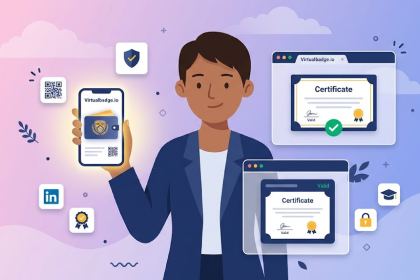
Apprentices receive their credentials by email or directly through a learning management system. From there, they can add the credential to their LinkedIn profile, store it in Apple Wallet or Google Wallet, or share a direct link with a potential employer. The credential stays valid and verifiable regardless of where or how it is shared.
Digital credentials offer clear advantages for both sides of the vocational training relationship:

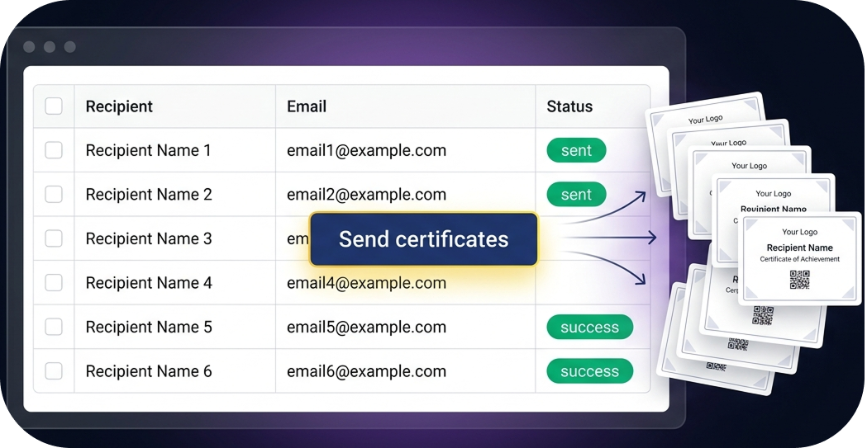
Adopting digital credentials does not require overhauling your entire system. Most vocational providers can get started in a few straightforward steps.
For more information, read: The Complete Overview of Digital Certificates and Badges
Vocational training providers who move to digital credentials position themselves as modern, trustworthy, and easy to work with. Apprentices get credentials they can actually use in their careers, and employers get the instant verification they need.
Virtualbadge.io gives you everything to make this happen: a flexible badge and certificate designer, bulk issuance, LMS integrations, verification pages, and one-click sharing to LinkedIn and digital wallets.
Book a free demo and see how easy it is to bring your vocational credentials into the digital age.
* You can find the organisation ID in the URL when you access your LinkedIn Company page as an admin.


Marketing

Jun 16, 2026

5 min
A note on how we write: we use AI tools to help with research and drafting. Every article is then reviewed, edited and fact-checked by someone on the Virtualbadge.io team before it goes live. The final word is always human.

Use Virtualbadge.io to design and send digital certificates that create trust - in less than 10 minutes.
%20(1).svg)