No user accounts required for your recipients -
Start your 7-day free trial now!

How companies and education providers connect learning outcomes and HR processes through open standards and API integrations


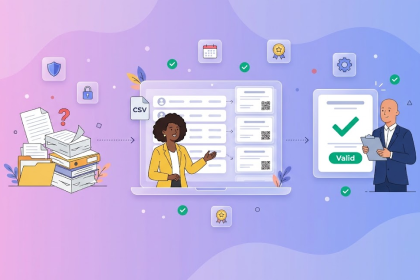
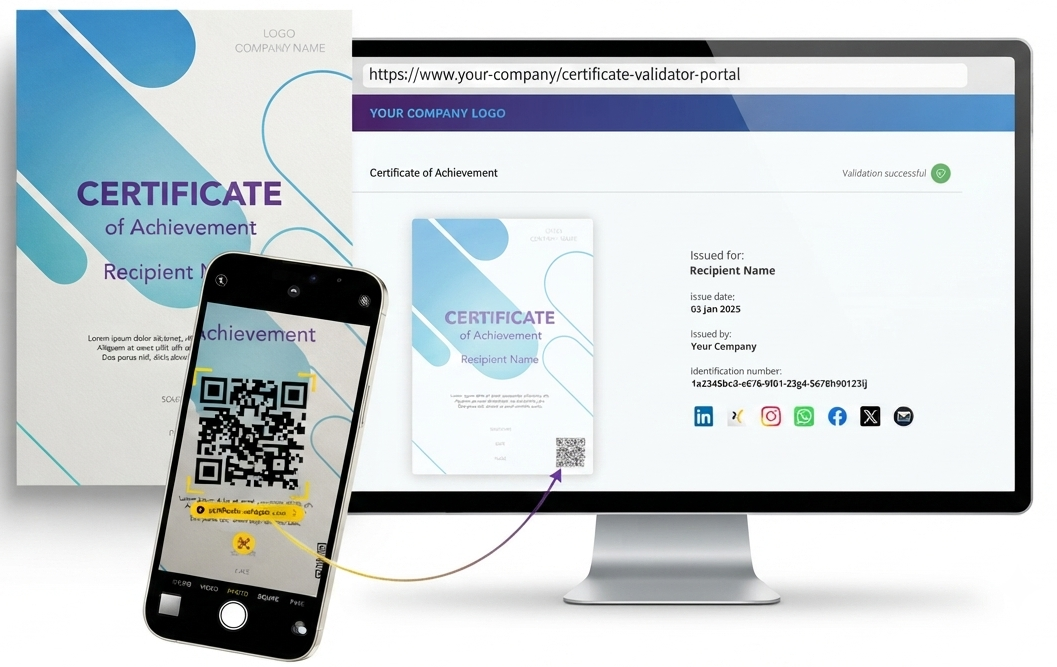
Digital accreditation refers to the electronic issuance and verification of qualification records. Unlike scanned certificates or static PDF files, digital credentials contain structured metadata, a cryptographic signature, and a verification link, so authenticity can be checked at any time.
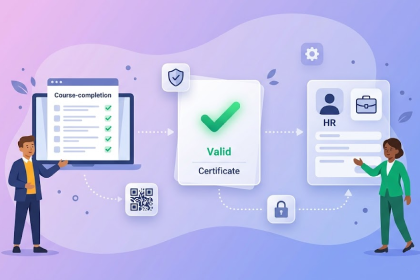
In many companies, these records still remain isolated. The learning management system stores course completions, while the HR department manages qualifications separately in the employee record or as an email attachment. This separation costs time, leads to outdated data, and prevents automated workflows such as reminders before a mandatory training expires.
The need for a seamless solution grows with the volume of continuing education and micro-credentials that companies issue today. Employers increasingly expect verifiable digital records instead of scanned documents, and HR managers need an up-to-date overview of qualifications without tracking every certificate individually.
The data flow follows a clear pattern. When an employee completes a course, the learning management system sends a webhook or API call with name, email address, course title, and completion date to the credential platform. The platform creates a signed certificate, sends it to the recipient, and can trigger a second API call to the HR system in parallel to update the employee record.
Structured preparation makes implementation significantly easier:
Logistics provider 4flow shows how badges for internal skill recognition can be integrated with HR processes, having built a structured badge program for internal skills. Read the details in the 4flow success story.
Digital credentials contain personal data and are therefore subject to GDPR. Document what data is collected, how long it is retained, and who has access to it.
The eIDAS 2.0 regulation is also bringing the EU Digital Identity Wallet closer. By the end of 2026, member states must provide a compliant wallet, which is likely to further increase demand for standards-compliant, verifiable credentials.

Connecting the learning management system, credential platform, and HR software eliminates media discontinuities and makes qualification records available exactly where personnel decisions are made. The key lies in preparation, clear issuance criteria, standardized data, and an integration method that fits your technical resources.
Virtualbadge.io offers REST API access, Zapier integration, and a free trial period where you can try out design, issuance, and verification directly. Schedule a free demo and find out how digital accreditation can integrate into your existing HR and learning landscape.
How long does a typical LMS-HR integration take?
A Zapier-based automation is often set up within a few hours. Individual API integrations usually take a few days, depending on the system landscape.
Can already completed courses be digitized retroactively?
Yes. Using CSV import, recipient lists can also be uploaded for past courses, and digital certificates can be issued retroactively.
Is the transferred personnel data protected in compliance with GDPR?
Yes, provided the platform used processes data on European servers and offers a data processing agreement, as is the case with Virtualbadge.io.
* You can find the organisation ID in the URL when you access your LinkedIn Company page as an admin.


Marketing

Aug 26, 2026

4 min
A note on how we write: we use AI tools to help with research and drafting. Every article is then reviewed, edited and fact-checked by someone on the Virtualbadge.io team before it goes live. The final word is always human.

Use Virtualbadge.io to design and send digital certificates that create trust - in less than 10 minutes.
%20(1).svg)