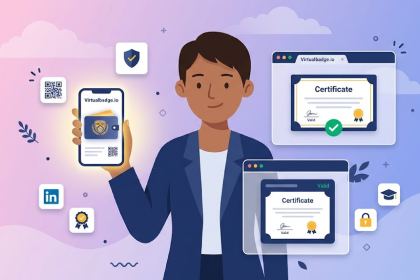
No user accounts required for your recipients -
Start your 7-day free trial now!

How generative AI makes fake certificates and fake validation domains easier to pull off, and how Virtualbadge.io and AI Fraud Protect work together to stop both.


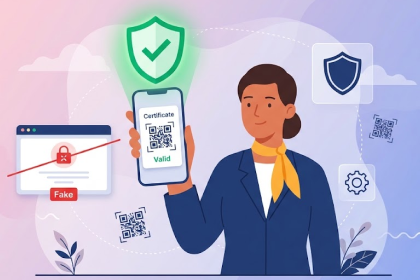
Certificate fraud used to mean a doctored PDF, easy enough for a careful eye to catch. That has changed. Generative AI now lets almost anyone create a convincing fake certificate in minutes, and a second, quieter threat has emerged alongside it: fraud aimed at the system built to verify credentials, not just the credential itself.
Both risks matter for any organization issuing certificates or badges. One threatens the document. The other threatens trust in verification itself, which is arguably worse, since it undermines the safeguard meant to catch the first problem. Closing only one of these gaps still leaves an organization exposed on the other, so it helps to look at both in turn before deciding where to invest first.
Image generators, chatbots, and free design tools have removed most of the skill a forgery once required. What this makes possible:
This breakdown of AI-driven document forgery explains how consumer-grade tools collapsed that barrier.
The damage rarely stops at one document. A fake certificate carrying an organization's name chips away at the credibility of every legitimate one it has issued, and issuers can end up fielding awkward questions from employers or regulators asking them to confirm whether a piece of paperwork is genuine.
No standard PDF, however well designed, can prove after the fact that it hasn't been altered or copied. That is why more organizations are moving to credentials with built-in proof of authenticity, instead of relying on how convincing a document looks.
For more information, read: How to Protect Your Certificates from AI Fakes
Many issuers protect certificates with a unique validation link or QR code that leads to a verification page. It is a strong defense, but only if that page can be trusted.
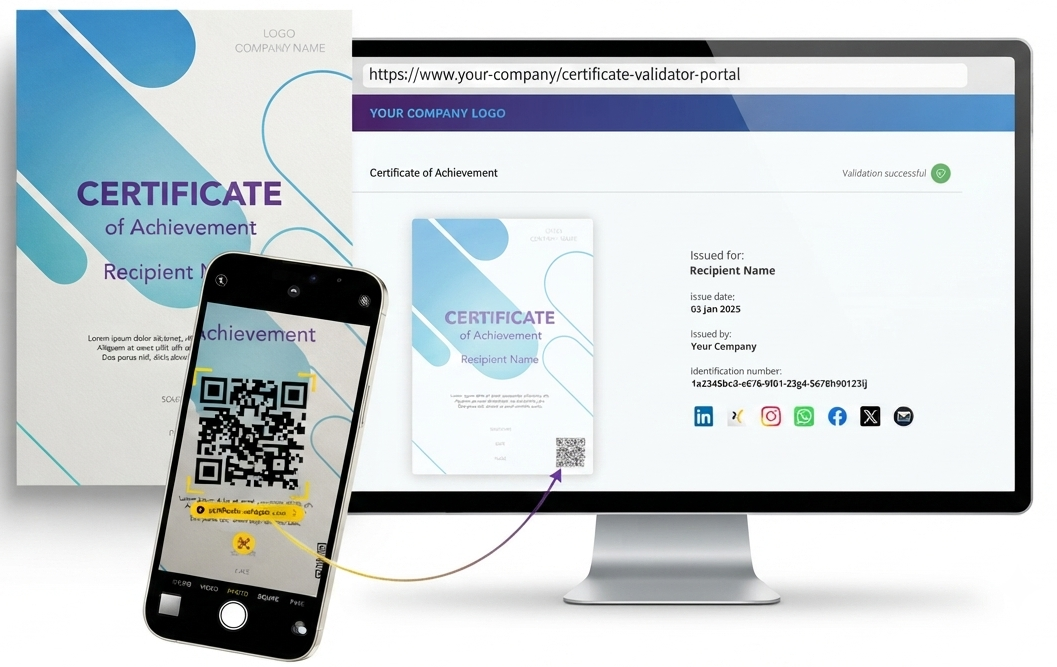
Fraud actors now build lookalike domains to defeat it:
On the copycat page, every certificate, including their own fakes, gets marked as valid. Almost no one checking a QR code reads the resulting URL closely enough to notice.
It is the same trick behind classic email phishing, just aimed at a different target. Instead of a fake login page waiting for someone to type in a password, it is a fake validation page waiting for someone to trust a checkmark. A page at yourdomain.com/validation and a copy at your-domain.com/validation can look pixel-for-pixel identical, same layout, same green checkmark, same wording, and the only real difference is one extra hyphen in the address bar that almost nobody stops to check.
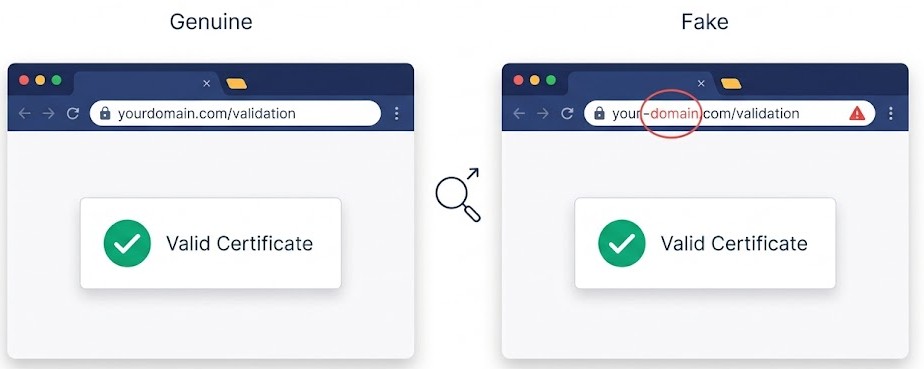
This is more damaging than a single fake certificate. It compromises the entire verification mechanism an organization spent years building trust in, for every credential that mechanism was ever meant to protect, and it can go unnoticed for a long time.
Virtualbadge.io closes the first gap by design:
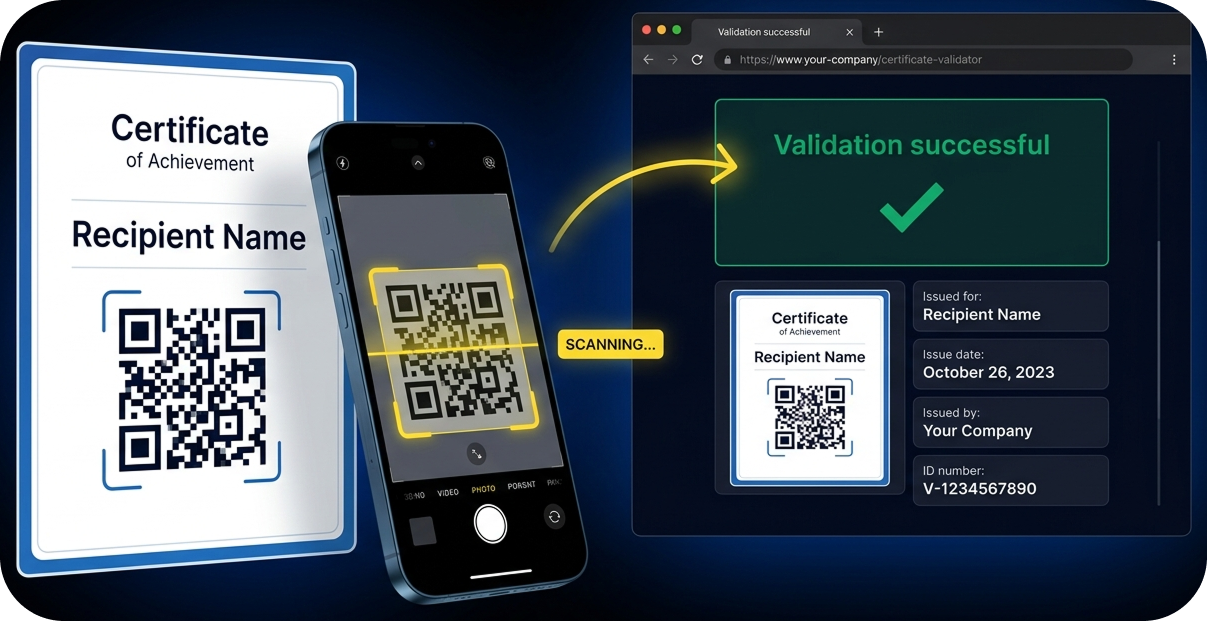
Together, this ties a certificate provably to its original issuer, since copying a design no longer fakes it convincingly.
Closing the second gap needs ongoing monitoring, not a one-time setup. That is what AI Fraud Protect, a product from FutureNext GmbH, the company behind Virtualbadge.io, is built for:
Together, Virtualbadge.io and AI Fraud Protect cover both sides of the problem: one makes certificates hard to fake, the other makes sure the page confirming them cannot be faked either. Neither piece is much use on its own once fraud starts scaling.
Certificate fraud is not a rare edge case anymore. It is a predictable result of how easy AI has made both document creation and domain registration. Organizations still relying on static PDFs or an unprotected verification page are exposed on at least one of these fronts, often without realizing it until a fake credential or a fake validation page has already been circulating.
Virtualbadge.io lets you issue cryptographically signed certificates and badges with your own branded validation page in days, not months, so both risks are covered from day one rather than patched after the fact.
See how it works with a free demo, and find out where your certificate process might already be exposed today.
* You can find the organisation ID in the URL when you access your LinkedIn Company page as an admin.


Marketing

Sep 24, 2026

6 min
A note on how we write: we use AI tools to help with research and drafting. Every article is then reviewed, edited and fact-checked by someone on the Virtualbadge.io team before it goes live. The final word is always human.

Use Virtualbadge.io to design and send digital certificates that create trust - in less than 10 minutes.
%20(1).svg)