No user accounts required for your recipients -
Start your 7-day free trial now!

Certificate of attendance, certificate, and diploma are often used interchangeably in everyday language, yet they differ significantly in legal and content terms.



Anyone who takes part in a seminar, workshop, or short training course usually receives a certificate of attendance at the end. It confirms attendance only, not the assessment of knowledge or skills. As a rule, minimum attendance is required, often around 80 percent of the instruction time.
Certificates of attendance are mainly used for short formats, such as one to multi day seminars, internal training sessions, or conference workshops that end without a final assessment. For education providers, this is the simplest form of documentation. The goal is to make engagement visible, not to pass an exam.
Even so, a certificate of attendance should look professional and be clearly identifiable. The name of the participant, the title of the event, the date, and the issuing organization should always be included, even if no grade or evaluation follows.
A typical example from practice: An education provider runs a half day workshop on digital presentation techniques. At the end, all participants who attended receive a certificate documenting their attendance, without any final test. For internal training records or as proof for an employer, this is entirely sufficient.
A certificate goes one step further. It confirms not just attendance, but competencies achieved, usually after a test or another form of performance assessment. A clearly defined minimum scope of training is common, combined with a passed final test.

For education providers, this means a certificate should clearly document which competency was tested and against what standard. Many certificates also come with a validity period, for example for safety training or compliance training that must be renewed regularly.
Typical characteristics of a credible certificate:
One example: A language school offers a multi week course that ends with a written and oral final test. Only those who pass both parts receive the certificate, not just a certificate of attendance. This exact difference is what makes the document meaningful to future employers or authorities.
A diploma marks the highest level of proof and is usually more strongly anchored in law than a certificate or certificate of attendance. It confirms participation in a more extensive, longer lasting qualification that concludes with one or more internal examinations, such as a written exam, a project assignment, or an oral exam.
This is most evident in traditional vocational training. Qualifications based on the Vocational Training Act or the Trade and Crafts Code are recognized by the state and result in a final diploma with defined formal requirements. Universities also issue diplomas with grades or evaluation scales that go far beyond a simple confirmation of attendance.
For education providers issuing their own diplomas or diploma like completion documents, consistency is what matters most. Assessment standards, grading scales, and examination regulations should be documented transparently and comprehensibly, so that the document holds up with employers or further educational institutions.
A diploma differs significantly from a certificate of attendance or a single certificate in this respect: it usually summarizes several learning phases, exam results, and evaluations over a longer period, for example at the end of a complete vocational training program, a certificate program with multiple modules, or a degree program.
The boundaries between a certificate of attendance, a certificate, and a diploma may seem academic at first glance, but they are of great practical importance for education providers. Anyone who labels a simple short format as a certificate without any exam having taken place risks credibility with participants and employers. Conversely, it is worth clearly naming genuine exam achievements as such, so that the value is visible to recipients.
In short, the choice of the right format comes down to three questions:
Anyone who answers these questions in advance avoids misunderstandings and ensures that recipients, employers, and certifying bodies can trust the document.
Virtualbadge.io supports all three formats digitally: simple certificates of attendance as quickly issuable badges, verified certificates with an expiration date and a validation page, as well as more extensive, diploma like completion documents with individual design and clear verification via QR code.
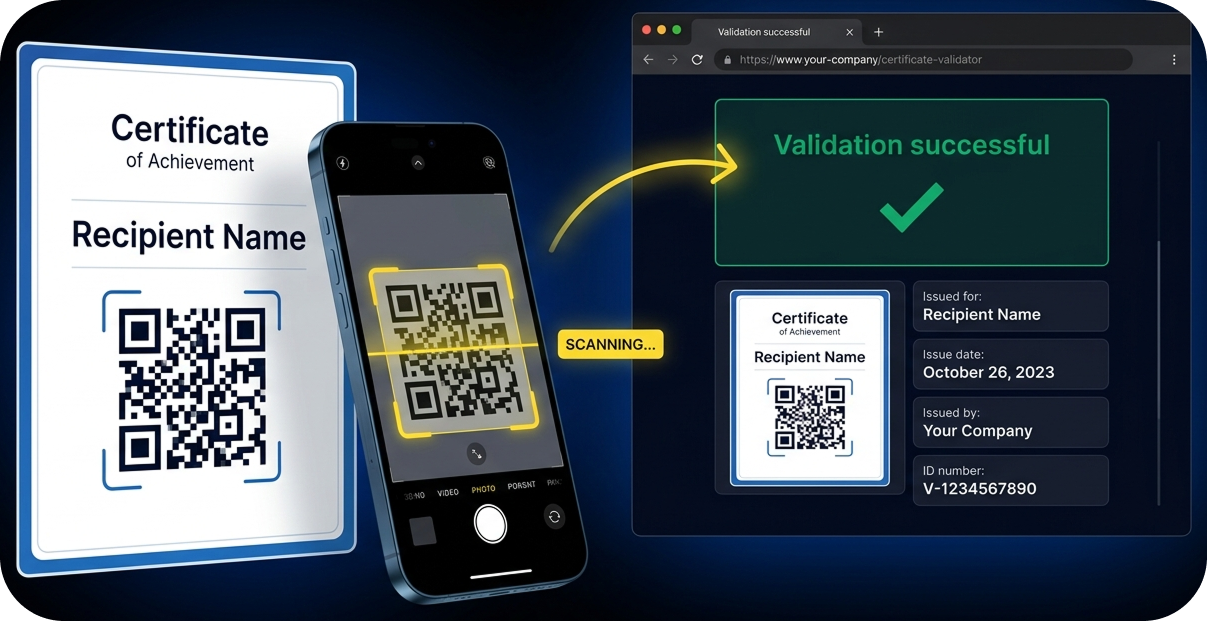
Every document can be checked through its own validation page, so recipients and third parties can always verify which format they are looking at and what it actually confirms.
Virtualbadge.io has covered the distinction between certificates, certifications, and certificates of attendance in education in the following article: Certificates, Certifications, Certificates of Attendance
Schedule a free demo and issue certificates of attendance, certificates, and diplomas digitally, securely, and verifiably.
* You can find the organisation ID in the URL when you access your LinkedIn Company page as an admin.


Marketing

Aug 5, 2026

5 min
A note on how we write: we use AI tools to help with research and drafting. Every article is then reviewed, edited and fact-checked by someone on the Virtualbadge.io team before it goes live. The final word is always human.

Use Virtualbadge.io to design and send digital certificates that create trust - in less than 10 minutes.
%20(1).svg)