No user accounts required for your recipients -
Start your 7-day free trial now!

Two types of documentation, two different statements: what education providers should consider when choosing the right document



A certificate of attendance simply confirms a fact: someone took part in something, was present at a location, or belonged to a group. It documents the event itself, not the performance achieved during it. No content assessment, examination, or grading takes place, and this is exactly what distinguishes the certificate of attendance from most other forms of documentation in education.
This is exactly why a certificate of attendance is particularly suitable for situations where proof of participation is the priority and no performance review is required. The administrative effort is low, issuance is usually straightforward, and it can generally be automated even for very large numbers of participants, for example directly after a live event or webinar.
Typical examples:
For recipients, a certificate of attendance is a useful document, but for employers or clients it carries limited weight, since it provides no information about the actual level of knowledge or competence. Anyone issuing a certificate of attendance should therefore label it clearly as such, rather than equating it with a certificate or a certificate of achievement.
A certificate of achievement, by contrast, documents a performance that has been tested and assessed. It is always issued in connection with a defined assessment basis, such as a written exam, a practical test, a project assignment, or an oral examination. The TÜV Rheinland Akademie describes this distinction well: a certificate requires that the content taught was "verified through an examination or proof of performance."
A certificate of achievement is therefore tied to clear criteria and is usually a prerequisite for issuing a full certificate.

It is frequently required in formalized educational contexts, such as at universities, in state recognized training programs, or in industry specific certifications with a clearly regulated examination process.
Typical examples:
For education providers, this means that a certificate of achievement requires more organizational effort than a simple certificate of attendance, for example in creating exam questions, grading, or documenting the assessment criteria. In return, it provides a far more reliable statement about the participant's actual competence, which makes it especially valuable to employers, regulatory authorities, and funding bodies.
The two documents are often confused in everyday use, but they differ in several key respects:
Anyone who understands these differences can choose the right document for each training measure, rather than defaulting to the same format out of habit. This is especially true when an educational offering provides several formats in parallel, such as a short information session with a certificate of attendance and a longer course with a final exam and certificate of achievement.
The choice between a certificate of attendance and a certificate of achievement is more than a formality. If a simple certificate of attendance is incorrectly presented as a full certificate, an expectation gap with employers, auditors, or regulatory authorities can quickly arise. This can damage the credibility of the entire educational offering, especially when participants later need to present the document to third parties.
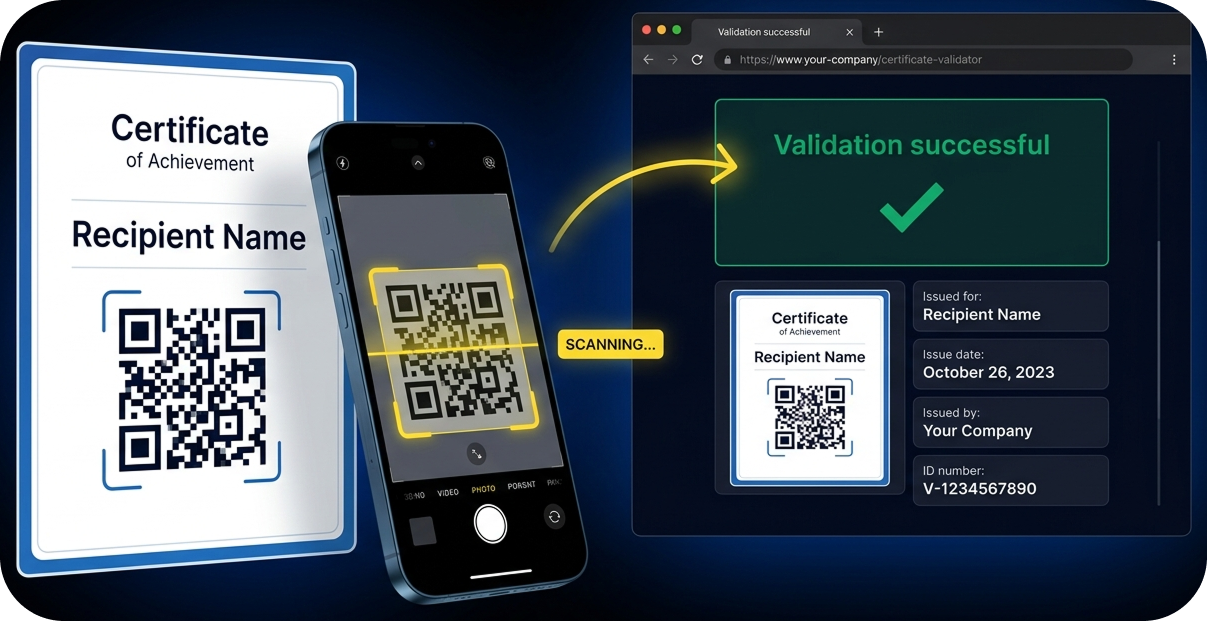
The reverse is also true: anyone issuing a genuine certificate of achievement should label it accordingly and document it in a traceable way, including the exam content, assessment criteria, and issue date. Digital, verifiable documents help communicate this distinction credibly, for example through a dedicated validation page that shows when and how a document was earned and exactly what was assessed.
The Swiss certification provider SIZ AG fully digitized its certificate issuance and achieved a 400 percent ROI in the first year. Read more in the SIZ AG case study.
Whether a certificate of attendance or a certificate of achievement, both document types benefit from being issued digitally, tamper proof, and easy to verify. With Virtualbadge.io, both formats can be clearly separated from one another, designed with custom templates, and sent out in bulk via CSV import. Each document receives its own QR code and validation page, so recipients and third parties can verify authenticity at any time.
This turns a simple formality into a reliable, digital document that builds trust and can be shared with ease.
* You can find the organisation ID in the URL when you access your LinkedIn Company page as an admin.


Marketing

Aug 5, 2026

5 min
A note on how we write: we use AI tools to help with research and drafting. Every article is then reviewed, edited and fact-checked by someone on the Virtualbadge.io team before it goes live. The final word is always human.

Use Virtualbadge.io to design and send digital certificates that create trust - in less than 10 minutes.
%20(1).svg)