No user accounts required for your recipients -
Start your 7-day free trial now!

How automated digital credentials help organizations prove, track and manage compliance obligations efficiently


Corporate compliance training is no longer optional. Whether it is data protection, workplace safety, anti-money laundering or industry-specific regulations, organizations across sectors are required to document that employees have completed mandatory training. The question is no longer whether to issue certificates, but how to do it in a way that actually holds up when it matters.
Regulators, auditors and legal departments do not accept vague assurances. They want documentation. In many industries, the ability to prove who completed which training, on which date, is a legal requirement with direct consequences if it cannot be demonstrated.
A PDF emailed to a participant or a spreadsheet maintained by an HR coordinator does not meet this bar. It can be falsified, lost or simply unavailable when needed. What compliance programs require is a certificate that is:
This is precisely what digital certificates are designed to provide. Each certificate carries structured metadata, a unique validation URL and a timestamp that cannot be altered after issuance.
For more on what compliance-relevant issuance looks like in practice, read: Digital Certificates in Regulated Industries: What to Watch Out For
For organizations running compliance training at scale, the administrative burden of manual certificate workflows is significant. Consider a company with 500 employees that must complete annual data protection training, quarterly safety briefings and role-specific certifications throughout the year. That is hundreds of certificates issued, tracked and renewed across multiple programs, often managed by a small HR team.
Common failure points in manual processes include:
When an audit lands, these gaps become expensive problems. The time spent reconstructing records, chasing down completions and preparing documentation represents a real operational cost, often on short notice.
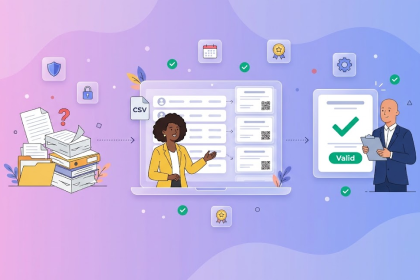
Modern digital certificate platforms allow training providers and corporate L&D teams to issue certificates automatically as soon as a participant completes a course or passes an assessment. There is no manual step, no delay and no risk of a certificate being issued to the wrong person or with incorrect data.
Each certificate issued through Virtualbadge.io, includes a unique validation page that anyone, including an auditor or employer, can check in real time to confirm the certificate is authentic and has not been altered.

The certificate cannot be copied or falsified in a way that would pass verification.
For compliance programs, this means:
For more on how to set up automated certificate workflows for employee training, read: How to Automate Certificate Issuing for Employee Training Programs
Issuing certificates is only half the challenge. The other half is maintaining a clear, up-to-date picture of compliance status across the organization. Who has completed what, when their certification expires and which gaps need to be addressed before the next audit.
A digital certificate platform with built-in analytics gives compliance managers exactly this visibility.

Completion rates, issuance history and engagement data are available in one place, exportable for reporting and ready for internal stakeholders or external regulators.
This level of oversight is difficult to replicate with manual processes. When everything is centralized and tied to verifiable credentials, preparing for an audit shifts from a weeks-long scramble to a straightforward reporting exercise.
For more on data protection and compliant credential issuance, read: GDPR for Credentials: Secure and Compliant Issuance
Organizations looking to modernize their compliance certificate workflows do not need to overhaul their existing training infrastructure. Virtualbadge.io integrates with common LMS platforms and supports bulk issuance via CSV upload, making it straightforward to add digital certification to existing programs.
The setup process typically involves:
From there, certificates are issued automatically and recipients can access, download and share their credentials immediately. The validation infrastructure is built in, with no additional technical setup required.
For more informations feel free to talk to our team. Book a free demo
* You can find the organisation ID in the URL when you access your LinkedIn Company page as an admin.


Marketing

May 13, 2026

4 min
A note on how we write: we use AI tools to help with research and drafting. Every article is then reviewed, edited and fact-checked by someone on the Virtualbadge.io team before it goes live. The final word is always human.

Use Virtualbadge.io to design and send digital certificates that create trust - in less than 10 minutes.
%20(1).svg)