No user accounts required for your recipients -
Start your 7-day free trial now!

How exam organizations find the right solution for tamper-proof digital certificates


The number of providers for digital certificate platforms is growing, but not every solution fits the requirements of exam organizations that issue thousands of credentials per cycle. Virtualbadge.io helps exam organizations issue tamper-proof digital certificates in minutes. This article shows you seven criteria that help you identify the right platform for your requirements.
Key Takeaways: Typical Selection Criteria for Certificate Platforms
Exam certificates are only as valuable as the trust that employers and authorities place in them. If a credential can be reproduced with a simple template and a stamp, there is no technical layer of protection against fraud.
That is why you should look for cryptographic signatures that uniquely secure every credential, as well as a publicly accessible validation page or a QR code that confirms authenticity within seconds. Employers can then check validity with a smartphone scan without having to contact you, which at the same time reduces your internal effort for verification requests.
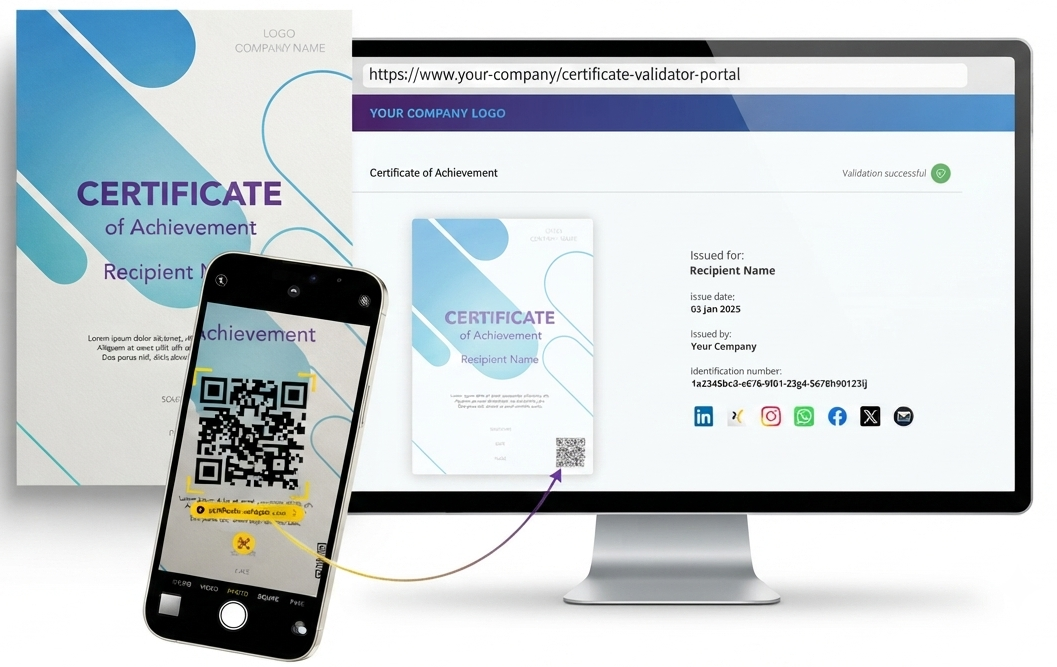
Also make sure that both the certificate and the validation page can be fully designed in your own corporate design, so that every credential consistently represents your brand rather than that of the software provider.
Exam organizations process particularly sensitive personal data: exam results, proof of identity, and detailed qualification information. The platform you choose must store this data exclusively on servers in the EU and fully cover the requirements of the GDPR.
Ask specifically about the location of the data centers, the retention periods, and the deletion concept for personal data. With providers whose servers are located outside the EU, there is a risk that a data transfer violates European data protection law. A data processing agreement and documented technical and organizational measures give you additional security during internal and external compliance audits.
In a typical exam cycle, you issue hundreds or thousands of credentials at the same time. Manual, one-by-one creation costs valuable working time, is prone to errors, and delays delivery to your exam candidates.
Your platform should support CSV upload and open programming interfaces so that certificates are automatically generated and sent right after an exam is passed. This also allows you to connect your existing exam software or your learning management system without manual intermediate steps. Virtualbadge.io saves exam organizations a lot of the previous manual processing time per exam cycle this way and eliminates typing errors in names and data.
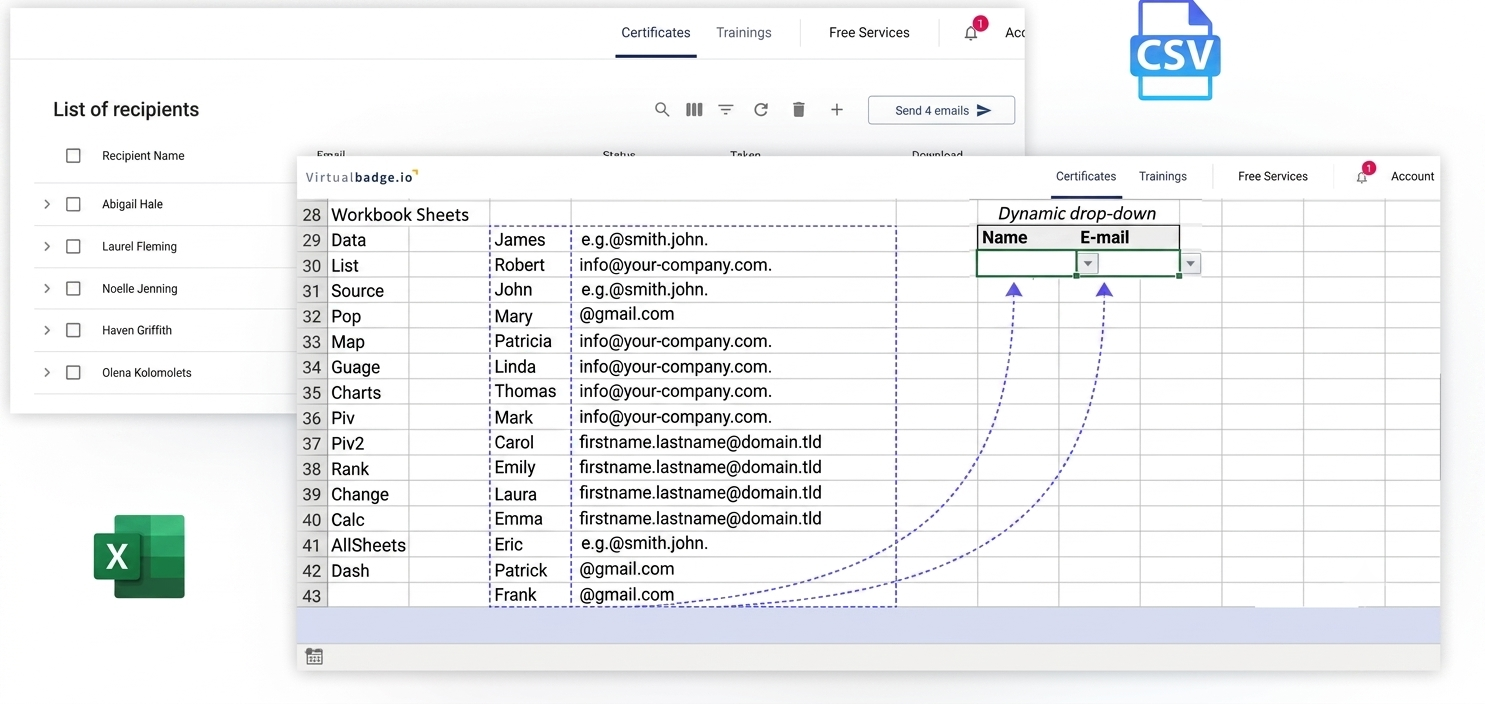
Medical device training provider IMN Training automated its certificate workflow for on-site training in this way and reduced the processing time per certificate from 60 to 10 minutes, as described in the case study.
Many exam organizations work with a network of regional exam centers or authorized partners. Each location must be able to issue certificates independently, while headquarters enforces uniform templates and quality standards. A multi-tenant system sets up each location as its own tenant and centrally manages templates as well as issuance quotas. telc gGmbH manages more than 3,000 authorized issuers in this way and issues digital certificates to around 1,500 exam candidates per day through Virtualbadge.io's management.
You should also pay attention to regulatory future-proofing: the eIDAS 2.0 regulation requires regulated sectors to accept the EU Identity Wallet starting in 2027, details of which can be found on the official eIDAS 2.0 information page. Your platform should therefore already support W3C Verifiable Credentials 2.0 and Open Badges. Virtualbadge.io is a signatory of the Bitkom EUDI Wallet MoU and is already prepared for this.
For more information, read: eIDAS 2.0: What Is Coming for Organizations in Europe
Choosing a digital certificate platform affects your processes, your external perception, and your compliance for years to come. Evaluate every option against all seven criteria and place particular value on forgery protection, data protection, and automation.
Virtualbadge.io was built specifically for the requirements of exam organizations and certification bodies in the DACH region and combines cryptographic security, multi-tenant management, and eIDAS 2.0 compliance in one solution. Schedule a free demo to see how Virtualbadge.io fits into your exam process.
What is a digital certificate platform?
A digital certificate platform creates, sends, and verifies exam certificates electronically. Virtualbadge.io cryptographically secures every credential and provides a validation page that employers can check within seconds.
Why is forgery protection so important for online exams?
Forged exam certificates damage the credibility of your accreditation and can have legal consequences. Cryptographic signatures make manipulation immediately detectable and protect your organization from reputational damage.
What does multi-tenancy mean for exam networks?
Multi-tenancy makes it possible to give each exam center its own access with defined permissions. Central templates and quotas remain controllable while each location operates independently to issue certificates.
* You can find the organisation ID in the URL when you access your LinkedIn Company page as an admin.


Marketing

Sep 24, 2026

6 min
A note on how we write: we use AI tools to help with research and drafting. Every article is then reviewed, edited and fact-checked by someone on the Virtualbadge.io team before it goes live. The final word is always human.

Use Virtualbadge.io to design and send digital certificates that create trust - in less than 10 minutes.
%20(1).svg)